
The Poison Squad by Deborah Blum
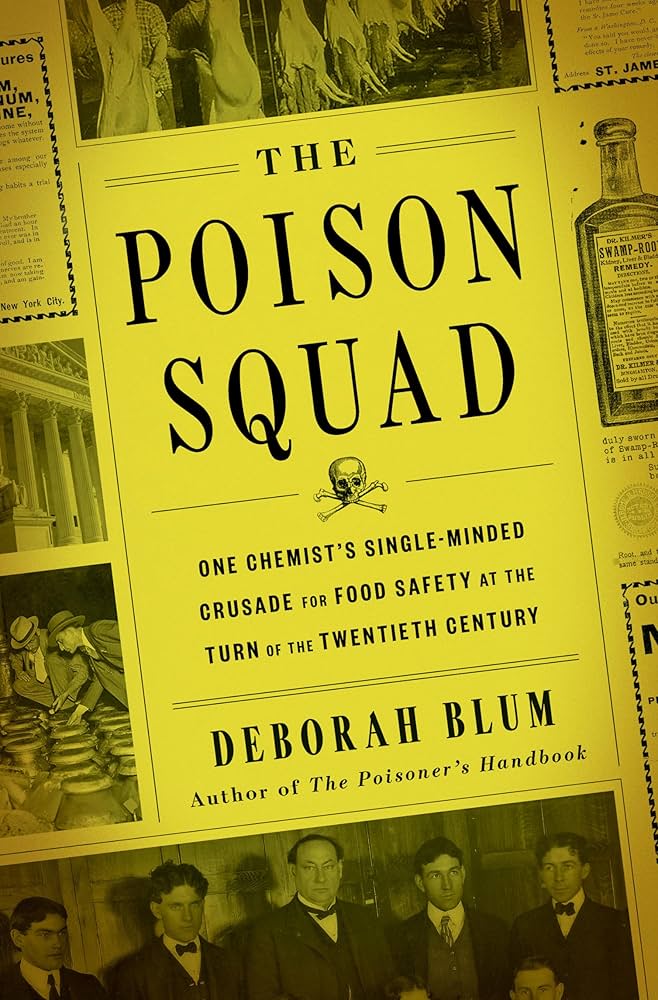
Our obsession with the health effects of what we eat may feel uniquely modern, but this excellent book chronicles the war against food adulteration in the late 1800s, which rhymes so perfectly with the current fights around saturated fats, microplastics, and ultra-processed foods. The author includes memorable renditions of the remarkably poor food quality (adding formaldehyde to preserve milk) and the big personalities of the time, including Teddy Roosevelt, Upton Sinclair, and our protagonist and father of the FDA: Dr. Harvey Wiley. To chemistry enthusiasts, food nerds, and anyone who cares about what they eat, it’s worth a close reading.
In this book, Dr. Harvey Wiley contends against the rising tide of Big Food: meatpackers, dairy farmers, whisky makers, and a young Coca-Cola Company.
As the United States shifted from an agrarian to industrial economy, farm produce turned into a commodity that needs to be piped from the countryside to cities and towns throughout the nation. However, in a time before widespread refrigeration, food spoiled quickly before it could arrive at the hungry consumer. Building on the marvels of industrial chemistry, clever food manufacturers added new and often under-researched compounds to keep their food “fresh”. Cue the horrors of formaldehyde in milk, lead in flour, and petroleum-derived food dyes in everything.
As children and adults – especially those too poor to afford high-quality produce – suffered illness and deaths in the thousands, progressive crusaders tried to fight against well-resourced food companies. Chemists like Dr. Wiley realized that scientific studies offered the best bet of understanding the health effects of these additives. He ran a series of experiments where volunteers took varying amounts of these chemicals (the eponymous Poison Squad) and described their health effects. After his volunteers sickened from every one of the chemicals he tested, Dr. Wiley became more outspoken and assertive about the need for regulation.
Even with strong public and scientific support, his efforts failed to persuade a wary Congress to pass any regulation. Ultimately, Upton Sinclair’s The Jungle provoked massive public anger about the hidden horrors of the meatpacking industry and spurred President Roosevelt and other progressive politicians to pass the Pure Food and Drug Act.
Many of these names will be familiar to students of American history, but the strength of this book is to make clear the comparisons with the current fights between food manufacturers and public health officials. For example, high-fructose corn syrup, which almost everyone now agrees is a driver of diabetes, was a concern even back in the 1800s. As it does now, industry opposition smothered public outcry and assured the public that corn syrup is just as tasty and healthy as cane sugar – it even provided more energy!
To be clear, the FDA has helped a lot with food purity and safety. The FDA ensures our food is not lying to us about what ingredients it contains, but there is still not enough political will to ban or halt clearly unhealthy food like sugary sodas or processed red meat. Our food may not immediately sicken us, but public health experts can still point to the slow-acting poison of addictive and highly processed food. We still have far to go to truly remove the poisons in our food, and reading this book will teach you more about this long-running struggle.

