
The Age of Extraction (Tim Wu)
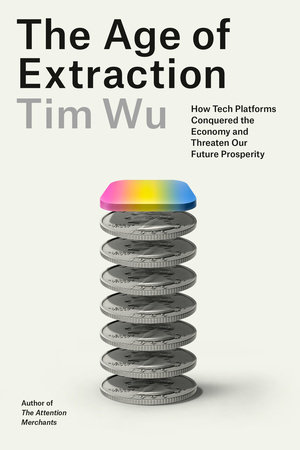
A short but fiery polemic written by a tech policy insider. Wu offers a lesson in the economic history of tech companies while making a strong anti-monopoly argument against the current tech giants. At the same time, his matter-of-fact prose hides a deep nostalgia for the 1990s and early 2000s when the internet was a (leftist?) utopia of opportunity, egalitarianism, and freedom. His conversion to tech skepticism leaves behind deep scars that no amount of policy wonk-coded prose can cover. If you read this book enough times, perhaps you will become former FTC Commissioner and left-wing darling, Lina Khan.
I especially loved Wu’s deep dive into the trust-busting actions that he argues created Silicon Valley. Pivotal to this history is the ruling that AT&T could not patent the transistor nor compete in the consumer electronics industry, leading to the dominance of companies like Texas Instruments and Intel, setting the stage for Silicon Valley and American software dominance.
He includes two great metaphors here: giant tech companies are like the Titan Kronos from Greek mythology, consuming their own children to prevent them from usurping their father. In this telling, Google and Facebook routinely consume leaner startups, like Waze or Instagram, who might have one day compete with them. In his second metaphor, Wu argues that to combat this tendency, government must be like a gardener, preventing giant companies from overshadowing or killing smaller companies.
My major qualm with the book is an over reliance on anecdotal or historical evidence. Although Wu includes economic data and invokes economicists like Keynes often, he does not emphasize recent economic studies of monopolies and competition in the technology industry. In addition, despite his anti-monopoly arguments, Wu does not show much sympathy for government takeover of industry. He describes how Europe and Japan massively subsidized their tech companies while the United States took a hands-off approach. Ultimately, he argues that this policy difference explains why Silicon Valley prevailed over its European and Japanese counterparts. However, his case is somewhat undercut by China’s strong consumer electronics industry, which was similarly heavily incentivized by the Chinese government. Following the story of monopoly in the economics literature could have given Wu a better footing and avoided any historical cherry-picking.
Overall, I enjoyed this short read and learned quite a lot about the history of technology companies during both the golden era of the semiconductor and the golden era of the Internet. Wu briefly applies his arguments to AI companies, where we are seeing signs that some of the tech giants may fade into the past. While this section of the book is not as fleshed out, it is likely the most important part. Wu notes how the tech giants are still the biggest funders and sponsors of the promised “AI Revolution.” In this argument, his skepticism about AI is not about their capabilities to replace labor. Rather, he is fearful of the concentration of power within a few hands that AI may enable. He makes a stirring call to action for what should be a non-partisan position: information should not be a monopoly.
 All 2 Soon