
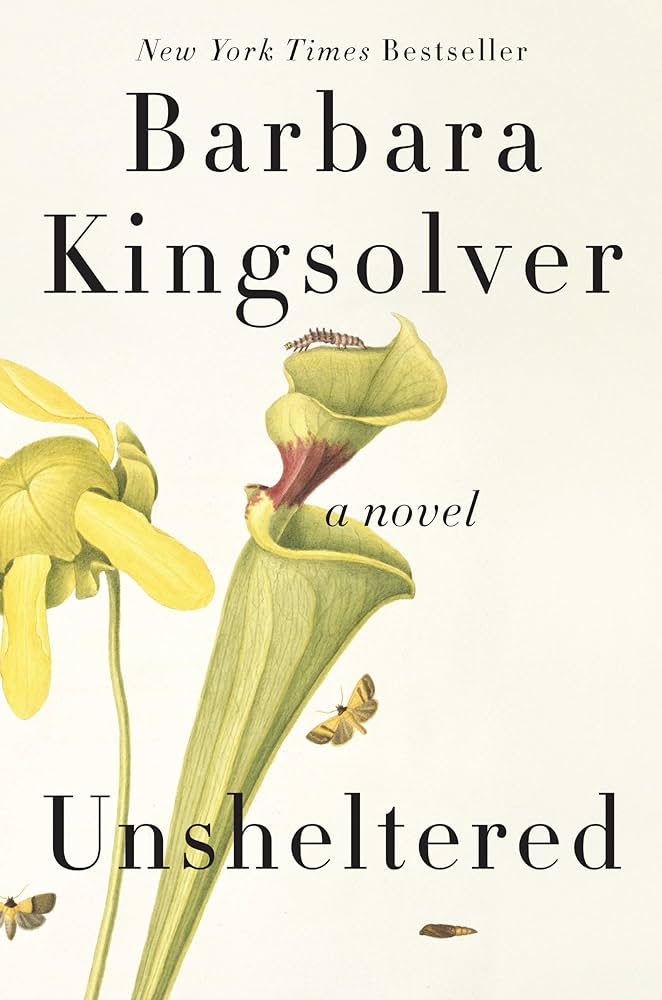
A gorgeously bittersweet novel that jumps between two families who inhabit the same home: one in 2016 and the other in the 1880s. For both families, the biggest threat to their lives is the decaying house around them. And in both families the house’s disrepair reflects the decaying society they inhabit. Kingsolver – who is now even more famous for Demon Copperhead, her blue collar West Virginia adaptation of Dickens’ famous novel – writes incredibly believable characters who somehow fascinate you without surprising you. I felt propelled throughout the book by moral urgency and bleeding sympathy for people living in a broken reality. The novel is ultimately a hopeful tale about community that you can hold close to your heart.
In the 1880s, a science teacher from Boston moves with his wife and her family to a utopian community in New Jersey. He is a newly converted disciple of Darwin and hopes to teach his theory of natural selection. In 2016, a middle-aged journalist and her husband must take care of their infant granddaughter and son after his wife’s suicide. Overeducated and underpaid, she tries to make sense of her new life living in a multigenerational household and as caretaker of an motherless infant and a dying father-in-law.
The problems each of our two protagonists initially face are exactly the same: the disintegrating house they live in. But quickly we realize that the underlying problems are not physical. Thatcher, the science teacher, must choose what he is willing to risk to teach the truth that science offers. Willa, the journalist, must choose how much of her dreams for her children and her future she is willing to give up. Rather than push these conflicts to a breaking point for the sake of narrative tension, Kingsolver’s prose moves at the pace of the real world. Events transpire. People make choices and new friends. Over the course of several critical months, a new path emerges from this tangle of people, the world, and conversations.
I can’t decide which plotline I like more. On one hand, Thatcher’s fight for truth over belief has clear heroes and villains. He befriends his neighbor Mary Treat, a famous botanist and correspondent of Darwin in real life, who inspires him to courage. His enemies, including the principal of the school and the despotic mayor of the town, are easy to hate: small-minded and greedy in equal parts, their intolerance is unfortunately resonant in these modern times.
In fact, this resonance surprised me the most. How is it possible that in this modern age we are back to arguing about teaching evolution and religion in schools? How are we still skeptical of vaccines and scientific research when almost every human has access to a device connected to all human knowledge in the world? The answer Kingsolver provides is social conformity: the small town Thatcher lives in runs as a cult of personality, and after the horrors of the Civil War, everyone wants to just get along with each other. Unfortunately, social conformity cannot quell all conflict, especially between younger and older generations. Thus, a school in the small town proves the arena for a fight between truth and convenience. Kingsolver’s plot shows that the solution is simple: create a community to fight for the truth and shame the conservative authority. Yes, they will respond with rage and repression – but this response cannot coexist with respect for authority.
Kingsolver’s second plotline provides a prescient window into the conflicts that roil America now. Willa’s family ranges the entire political spectrum. Her father-in-law is a former blue-collar worker and early Trump supporter. Her daughter is a committed leftist who lived for many years in Cuba. Her son is an epitome of the neoliberal elite. She and her husband are centrist Democrats. Each of these belief systems exist in segregated media ecosystems in the world now, but when they all live together and rely on each other, they must learn to accommodate and adjust.
Willa’s daughter – diametrically opposed to her grandfather in almost every political and social view – becomes his most trusted caretaker and confidant. She doesn’t try to change his beliefs: she understands they come from a well of deep anger. He lived and grew up in a world where rich WASPs had all the power. The unspoken agreement was that people like him – working-class and European but not Anglo-Saxon – would be next in line to rule after their white bosses passed away. They saw instead that the Civil Rights Movement and social change granted power to a diverse coalition: women, people of color, and queer people. They feel like these groups should have “waited in line” for their turn. Clearly, this view is nonsensical: two wrongs do not make a right. But it’s a belief system with a lot of power, and Kingsolver argues in this book that the only way to solve this dilemma is forcing these groups to rely on each other. Multi-generational households aren’t a magic solution to racism and misogyny, but perhaps this sense of found family and community can heal some of the rifts in our nation.

