
Last year, American Eagle tried to sell jeans with a pun: “Sydney Sweeney has great jeans.” The campaign explicitly talked about genes, drawing attention to Sweeney’s blue eyes. For many viewers, the combination of a blond, blue-eyed White woman and the phrase “great genes” echoed the old idea from eugenics that some people inherit superior traits. Others saw an overreaction to an ad, and American Eagle insisted it was only about jeans. The argument itself was revealing: even a commercial for clothing could set off a national debate about what we imagine genes can explain.
In science, that fixation has more serious consequences. Recently, individuals gained unauthorized access to data from the NIH-funded Adolescent Brain Cognitive Development (ABCD) study, which follows thousands of children as they grow up, and used it to rank ethnicities by average IQ score1. They used this data to argue that White Americans are inherently smarter than other races due to their genes. Online scientists quickly pointed out that the IQ differences in the data may arise from socioeconomic factors, but it was too late. White nationalist accounts and chatbots like Grok parroted the false results, creating the latest outrage cycle on the internet. Scientists running the ABCD study worried that research participants in the study would regret giving their data.
Why are people so obsessed with the relationship between race and IQ? Historically, this question is wrapped up in the beginnings of social science in the late 1800s2. Statisticians had started to systematically measure features of humans, like height, head shape, personality, and intellect. They eagerly interpreted their data using the newest and hottest theory in biology: Charles Darwin’s theory of evolution. Merging data and theory together, they developed a scientific field that came to be known as eugenics.
Central to eugenics is the idea that human features are subject to natural selection in the same way that animals are. By itself, this idea is perfectly reasonable. The best example we have of natural selection in humans is that societies that herd cattle can digest lactose as adults. All humans start out with the ability to digest lactose as children, but most eventually slow down at producing the enzyme needed as adults. However, for groups of humans that herd cattle for a living, digesting milk provides a valuable extra source of nutrition, and evolution selected for this trait in the population. Thus, we have evidence that humans may have been subject to natural selection in the past.
But eugenicists go one step further: they wanted to shape the direction of human evolution by choosing which humans were allowed to have children. They coupled this goal with racist beliefs that non-White (and specifically non-Nordic) peoples were inferior to blond, blue-eyed White people, whether in physical or intellectual ability. The United States put many of these ideas into practice in the 1920s, leading to mass sterilizations of women, and the Nazi party championed eugenics in the 1930s. With the loss of Germany in World War II and the horrifying genocide of the Holocaust, eugenics seemed to be discredited.
Unfortunately, this discreditating did not kill the racist ideologies that supported eugenics. With rising Black vs. White racial tension in the US during the fight for Civil Rights in the 1960s and 1970s, eugenics-adjacent figures continued to espouse the idea that White people were genetically smarter than Black people. However, mainstream scientists found strong evidence that socioeconomics factors mostly account for any differences between racial groups.
One of the best papers demonstrating this fight is from 1971 and was provocatively titled Race, Social Class, and IQ3. Here, Dr. Sandra Scarr directly tested whether IQ group differences arise solely from genetic factors or the interaction between genes and socioeconomic factors.
The two models of how genetics and environment interact in determining IQ
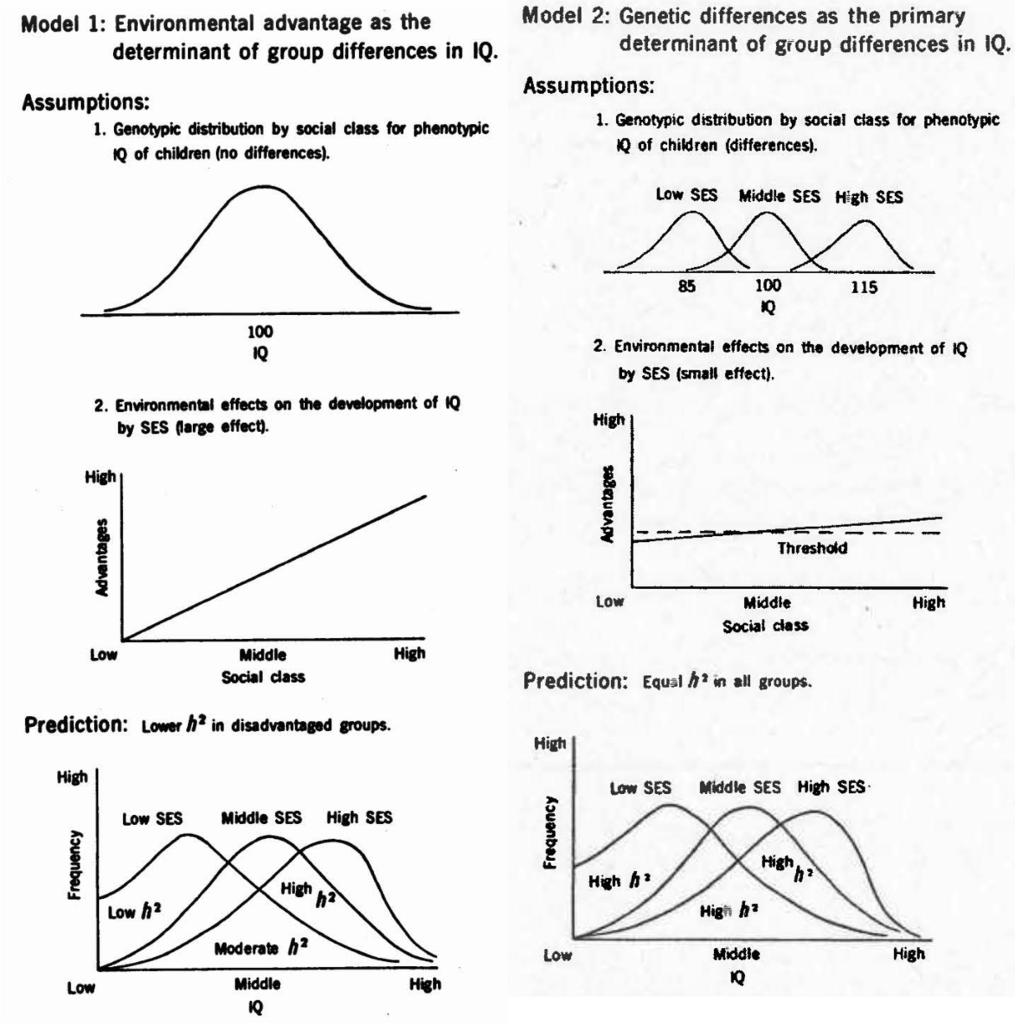
In the socioeconomic factor model, genetic differences in IQ are minimal between Black and White Americans, but the effect of a bad environment for poor children tends to squash the distribution of IQ. Black (and White) children who would thrive under better socioeconomic conditions are instead let down by low quality schooling. Wealthy White (and Black) children experience better schools and teachers, so their IQ develops as far as their genes will allow. Thus, poor children end up with lower IQs than rich children, and the Black vs. White difference may mostly be due to differences in poverty rates.
In the genes only model, eugenics is correct: poor children are genetically different from rich children, leading to an overall lower IQ from purely genetic effects. Thus, while child IQ differences in Black vs. White still reflect poverty, they are related via genetics rather than just the environment. In this model, placing a poor kid (whether White or Black) in a richer school district would not help. Rather, this model believes that poor people are inherently less intelligent due to their genes, perhaps due to the tendency for people to marry others within their social class.
Dr. Scarr figured out that these two models make different predictions about heritability: the proportion of variance in a trait that depend on genetic factors. The first model predicts that poor children will show less heritability of IQ compared to rich children because any genetic influence that could lead to a higher IQ is squashed under the weight of the bad environment. The second model states that heritability is the same across poor and rich children. The only difference is which genes poor and rich children have.
By carefully studying the performance of Black and White twins across Philadelphia and relating it to estimates of parent income from their census tract and education, Dr. Scarr found that poor children have significantly lower heritability of IQ compared to rich children, regardless of whether they are White or Black. Her findings challenged the eugenics model and showed that poor environment alone can reduce the heritability of IQ. The most important policy implication of her work was that differences in the IQ of poor and rich children are NOT simply due to rich children having better genes than poor children. Rather, poor children need better teachers and schools so that they can flourish the same way that rich children can.
Unfortunately, eugenics continues to survive and periodically rears its head up again every few decades. In the charged racial atmosphere of the 1990s, a book called The Bell Curve by Herrnstein and Murray argued that because IQ has high genetic heritability, America is gradually forming a cognitive elite who may be genetically different from the rest of the population. These zombie ideas from eugenics – ones that are clearly unsupported by scientific evidence – continue to circulate in white nationalist circles, funded by organizations like the Pioneer Fund. In fact, some of the “researchers” involved in unauthorized access to the ABCD study data had ties to this organization.
The scientific community continues to fight back. Recently, a group of researchers from WashU in St. Louis4 used the same ABCD study data to critically examine brain-IQ relationships. In trying to understand how the brain supports intelligence, scientists have long investigated what structural properties of the brain are correlated to IQ. Although they have only found weak correlations so far, this finding still raises the specter of genetic determinism: people born with a certain brain are more likely to have a high IQ, which is correlated with future career and economic success. This finding can lead to eugenics-like arguments. Should we limit certain jobs or certain rights to people with the “smart” brains?
As it turns out, this question may mix up cause and effect by ignoring how socioeconomic factors impact both brain development and IQ scores. Instead, children from wealthy households may experience less stress and therefore have differences in brain development compared to poor children. Simultaneously, because of their privileged upbringing, they are better prepared to take IQ tests. Thus, to infer a relationship between brain structure and IQ, we need to account for socioeconomic factors that impact both.
To do so, the researchers correlated hundreds of social, cognitive, and mental health variables with brain development. They found that socioeconomic factors are the most correlated with brain structure, much more strongly than IQ or mental health.
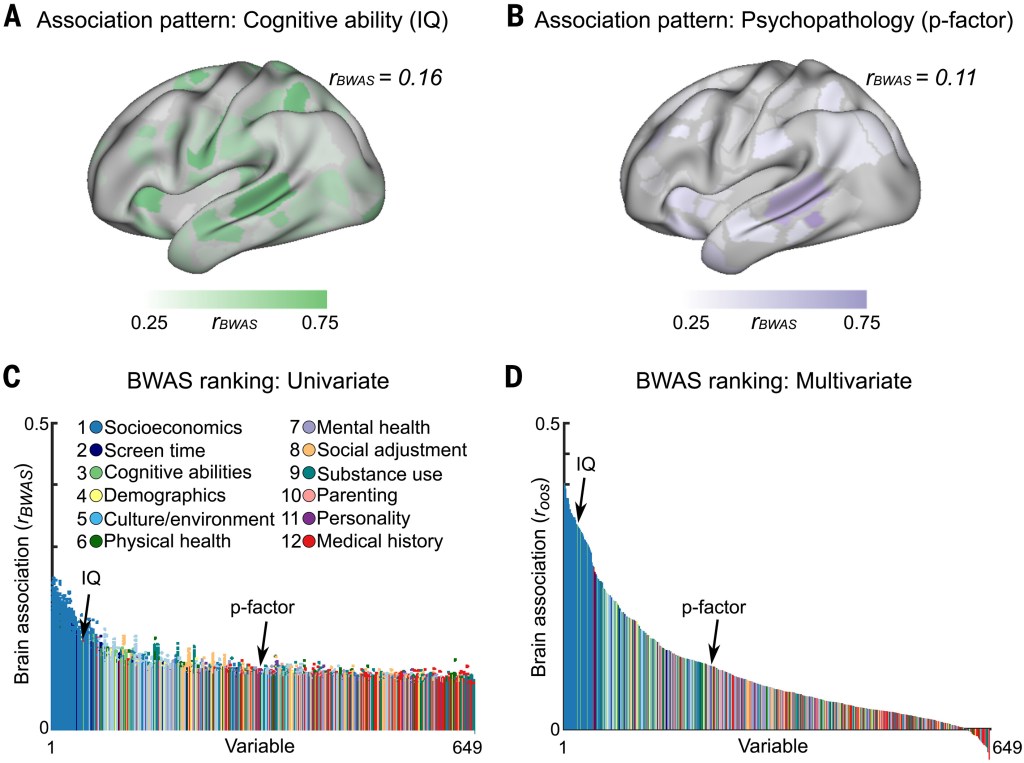
Socioeconomic variables are much more related to brain structure compared with IQ or mental health
Furthermore, the researchers found that this relationship between brain structure and socioeconomics matches the pattern of sleep deprivation, stress, and screen time. Thus, the relationship between brain and IQ may be driven by sleep and stress differences between rich and poor children.
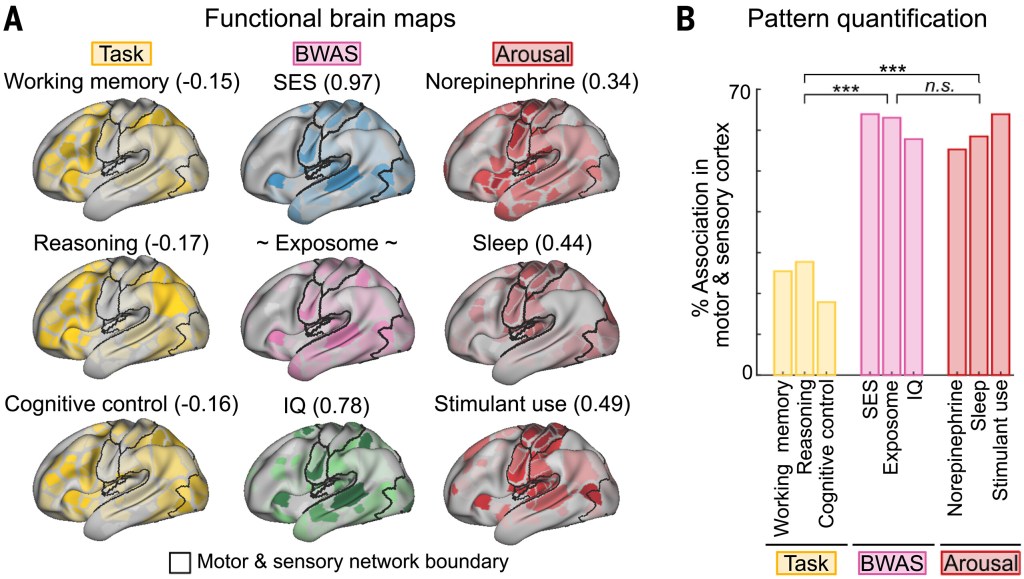
Socioeconomic status and IQ are more related to sleep rather than cognition.
Overall, the environment that one grows up in – both the resources and the stressors – matters a lot. In fact, only in a rich and resource-abundant world can we see the full effect of your genes. Even if you believe you have “great genes”, the world you live in determines how much they matter.

